Lessons for Unison #3
RMT’s predecessor, the National Union of Railwaymen (NUR), had historically been relatively moderate and ineffective. When Dr Beeching slashed Britain’s railway services in the 1950s and ’60s, the union did next to nothing to fight the cuts and closures. By the ’70s, railway workers were overworked and underpaid.
Moreover, the union was a pillar of the right wing in the Labour Party. A stark illustration of this was Sidney Weighell, the union’s General Secretary from 1975. Weighell led a union that failed to fight against the decline of the railway and the widespread low pay among its members. At Labour Party conference in 1982, the NUR’s delegation decided to vote for the National Union of Mineworkers’ candidate in the election for Labour’s National Executive. Weighell, however, secretly cast the union’s vote for the candidate of the right-wing union EETPU.
When this came to light, Weighell resigned, but continued to assert that his actions were correct, saying “I’m glad to have been a casualty if it means that the party executive does not fall into the hands of militants.”
From right to left
Jimmy Knapp replaced Sidney Weighell as NUR General Secretary. Knapp was the left-wing candidate, and Weighell described him as “a stooge of the Communist and Trotskyite Left”. Although of relatively low rank in the union, Knapp comfortably beat the incumbent Assistant General Secretary Charlie Turnock.
However, Knapp went on to disappoint his supporters. He presided over a huge drop in the union’s membership, and when the Conservative government moved to privatise British Rail in the 1990s, Knapp led a weak union response which failed to inspire members to vote for the industrial action that could have stalled the sell-off and protected workers’ rights.
By 1997, when I started working on London Underground and joined RMT, Knapp was widely seen as bureaucratic, ineffective and, in union terms, right wing. When he stood for re-election in 1999, many of the union’s left-wing, militant members wanted Assistant General Secretary Bob Crow to oppose him, but Crow refused. Greg Tucker stepped up as a left challenge to Knapp but could not defeat him.
Crow was re-elected as RMT Assistant General Secretary in 1999, beating Mick Cash (who would go on to become General Secretary after Bob’s death), who stood on a platform arguing that the hard left had too much influence in the union and that RMT was too ready to strike.
Perhaps Crow was biding his time before stepping up to the top job. Two years later, Knapp died.
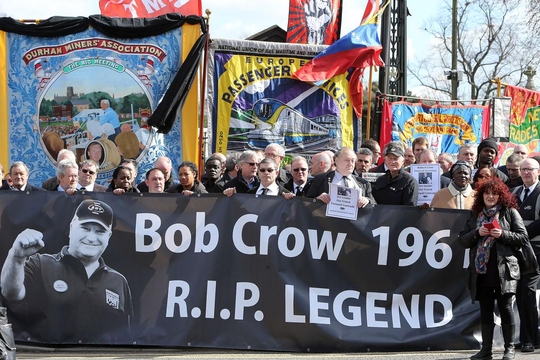
Bob Crow
Bob Crow had grown up in a working-class family in Essex and East London, and was very much influenced by his dad George, who was a trade unionist and communist. Young Bob joined the Communist Party (CP).
He got a job as a track worker on London Underground and joined the NUR. Bob became a union representative for his workmates.
He was critical of the union’s leadership, and won the support of others who shared these criticisms. He was elected first to the union’s Executive and then to the post of Assistant General Secretary (AGS). At the age of just 33, Crow was the youngest person ever to hold this post, and both his young age and his militant approach stood out in a union leadership still dominated by men who had neither.
Organising the rank and file?
In the early 1920s, the newly-founded Communist Party had members producing rank-and-file bulletins in railway workplaces, such as Harry Wicks’ Victoria Signal. Railway workers were also active in the Communist-led Minority Movement. However, once Stalin had led the counter-revolution in the Soviet Union and Communist Parties around the world were told to defer to the Kremlin, the Communists’ approach changed. Their priority became replacing right-wing union leaders with their favoured left-wingers. This contrasted with the view promoted by Trotskyists and other union activists that organising the union rank and file was more important and was essential in holding to account any left-wingers who were elected.
RMT, and the NUR before it, has had several left caucuses over the years. I remember at least two iterations of the Campaign for a Democratic and Fighting Union (CDFU), and a Campaign for Public Ownership of Public Transport. Despite their names, they spent little time organising industrial and political action and instead focused on getting left candidates elected to top union posts. All these were short-lived and disappeared once their candidates were in office. The new union leaders were left with no organised group to hold them to account.
In 1996, miners’ union leader Arthur Scargill left the Labour Party and founded the Socialist Labour Party (SLP). Bob Crow joined the new party, as did several other leading figures of RMT’s left wing. As far as they were concerned, there was now no reason to have a left caucus in the union. They had the SLP. Crow later left the SLP because he did not support it standing candidates against left Labour MPs such as John McDonnell.
Crow’s rise to power
Bob Crow was elected General Secretary in 2002, the year following Knapp’s death. He became the latest of the ‘awkward squad’ of newly elected union leaders pledged to stand up to the ‘new Labour’ government’s attacks on workers rather than sucking up to Prime Minister Tony Blair. Despite ‘new Labour’ backing one of his opponents and briefing heavily against him, Crow received more votes than both his opponents combined.
The new General Secretary combed through the union’s books and found that Knapp had wildly exaggerated the ‘financial crisis’ that he had used as a pretext for cutting union services and activity. Crow used the resources that he had unearthed to open new regional offices, set up the Organising Unit, introduce new technology to union offices, and open a new National Education Centre in Doncaster.
Crow removed senior union staff whom he found obstructive. He set up a phoneline for members to call to get direct access to help and support from the union. On his initiative, RMT set up a Credit Union for members. Bob relaunched RMT News in a new magazine format posted to members. Its pages reported on the many disputes and campaigns that the union was running.
Now Bob Crow was its General Secretary, RMT was taking more strike action and organising more public campaigning activity. In 2005, its Rail Against Privatisation campaign sought to raise the demand for renationalising the railway during that year’s general election campaign.
The union extended its organising work, and brought new sectors of maritime and transport workers into the union. For example, North Sea oil workers who had previously set up the Offshore Industry Liaison Committee (OILC) in frustration at the ineffectiveness of other unions on the platforms, became part of RMT in 2008 and have their own seat on the union’s national executive.
By 2008, he had presided over a rise in the union’s membership from 57,000 when he took office to more than 80,000. This was at a time when unions generally were losing members.
However, Crow also kept the basic bureaucratic structure of the union intact. While a few of the most stifling rules were changed with his support, he opposed further rule changes. The equalities committees were kept to a strictly advisory role, and he opposed the formation of a disabled members’ committee. The General Secretary’s salary remained significantly above what rail and transport workers were paid.
Changing political direction
Crow successfully proposed to the union that it reorganise its Parliamentary group to include only Labour MPs who supported railway renationalisation and other key RMT policies. He then successfully proposed that the union allow its branches to support non-Labour candidates on a case-by-case basis. As soon as it did so, backing Scottish Socialist Party candidates, Labour expelled RMT.
It is notable that the left could have pursued these (and other) policies at any point, but instead waited until the union elected a left-wing General Secretary and supported him in doing it. This reflects a culture in the union of loyalty to its leadership to the point of deference. It also accepts that the leadership decides the policies and the membership follows them, rather than the other way round.
Labour’s race to the right had been helped by the acquiescence of trade union leaders. When RMT branches tried to censure Mick Cash for voting with the Labour Party leadership over the Iraq war on Labour’s National Executive Committee, Bob Crow defended him. He reserved his fire for Labour’s leaders and steered the union out of the party it had helped to found.
Thereafter, Crow led several attempts to build a new organisation and to stand candidates in elections, including No2EU and the Trade Unionist and Socialist Coalition (TUSC).
Bob Crow’s leadership brought Stalinist politics into pole position the union. This saw the stepping up of enthusiasm for Britain leaving the EU, and opposition to support for free trade unions in Cuba. It also consolidated a culture of deference to a chest-thumping, big-man style of leadership.
Militant headlines
Bob Crow was seen as the most effective trade union leader of his time, and his confident, unapologetic militancy was a central factor in that. Crow rightly said that “whoever has muscle at the end of the day gets what they want … That is why I make no excuses about taking industrial action to look after our members.” While his predecessors had tried their hardest to hold members back from striking and appeared embarrassed when they went ahead anyway, Bob was bullish with the media, boosting members’ confidence by standing up for them unapologetically.
However, Crow did not always live up to the media’s image of him as an unrestrained class warrior dragging unwilling members to the barricades. While newspapers frequently ran headlines about the ‘union boss’ who ‘orders members to strike’, the truth was that every strike was authorised by a vote of members, and that on several occasions, Crow tried to settle disputes while members were still willing to fight for more. In one example, as London Underground workers shut down the capital by striking against the widely unpopular ‘Public-Private Partnership’, Crow persuaded the Executive to call off further strikes and recommend an offer from the employer which would have allowed the policy to go ahead with limited protections for workers. A meeting of workplace union reps voted to overturn Crow’s view, reject the offer and call more strikes, which led to a better deal, dubbed ‘Jobs for life’ by the press. (The PPP, however, still went ahead, only to collapse a few years later.)
While Crow supported women’s equality, he did not do much to tackle the macho culture of the union. He took over a union in which women were marginalised and under-represented, and that did not change nearly as much as women activists would have liked it to.
When members made complaints about bullying or other mistreatment by union officials, Crow’s priority was more to find a way to calm the issue than to deliver a just outcome.
Crow’s strengths included his willingness to accept criticism and disagreement within the union. He was safe in the knowledge that he could run the union how he wished and he wanted it to be a ‘big tent’.
Bob Crow, despite having some flaws, was a giant in the workers’ movement, and RMT a successful trade union built by generations of activists.
After Crow
After Bob’s untimely and unexpected death in 2014, those who sought to replace him each claimed his legacy. His first successor was his previous rival Mick Cash, who was re-elected five years later but then resigned after persistently falling out with the union’s Executive.
A group of RMT activists, prominently including supporters of the Communist Party and its newspaper the Morning Star, set up the RMT Broad Left, which was successful in getting its preferred candidates elected to office. However, some activists critical of the union’s leadership opposed the Broad Left for being a faction, not for its policies or strategies, and made a principle of not organising themselves into a group. Eventually, those who saw the need to organise set up RMT Rank and File. Launched in in January 2025, it is still finding its feet.
Cash’s successor, Mick Lynch, gained fame and popularity for his confident media performances. A pay dispute began in June 2022 with hard-hitting strikes that inspired many people. However, Lynch then steered it into a drawn-out process of naming occasional one-day strikes, calling some of them off, and gradually draining members’ morale. Workers in the Train Operating Companies and Network Rail ended up settling for pay deals which fell significantly short of what they could have won with a more effective strategy.
When Lynch retired, Eddie Dempsey was elected without opposition and remains as the union’s General Secretary.
Awkward
The first ‘awkward squad’ union General Secretary elected was Mick Rix in train drivers’ union ASLEF in 1998. Rix defeated incumbent Lew Adams on a pledge to make the Society more militant and independent of Labour’s leaders. However, by the time he faced re-election five years later, his bureaucratic leadership style meant that he lost to right-wing candidate Shaun Brady.
But RMT (and NUR before it) never votes its General Secretaries out. They either retire, resign, or die in office. The union’s National Executive Committee consists of rank-and-file members who are released from their jobs to work full-time for the union for the duration of their three-year term of office, but despite this, the General Secretary still dominates the union, and the drive to make a deal still dominates its approach to industrial relations.
There is an urgent need for RMT’s rank and file to assert themselves.
author
Janine Booth
Subscribe to Notes from Below
Subscribe now to Notes from Below, and get our print issues sent to your front door three times a year. For every subscriber, we’re also able to print a load of free copies to hand out in workplaces, neighbourhoods, prisons and picket lines. Can you subscribe now and support us in spreading Marxist ideas in the workplace?
Read next
Lessons for Unison #1
by
Unite the Union Activists
/
Jan. 24, 2026