Lessons for Unison #1
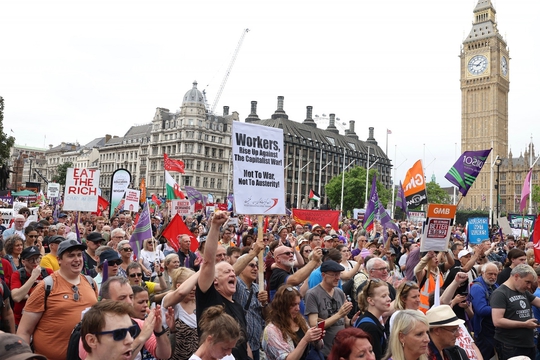
This week Andrea Egan officially took office as general secretary of Unison, the biggest trade union in the UK. A former social worker and leading figure in the internal ‘Time for Real Change’ group, Egan is the first lay member to be elected into the post, the first candidate to beat an incumbent, and now the first general secretary aligned with the left-wing of the union. Her manifesto pledged to democratise Unison, invest significantly in combative industrial organising, and put an end to the union’s subservient relationship to Labour. Her election marks an unprecedented opportunity to transform what has historically been one of the country’s most industrially conservative unions.
It will be far from easy, however. Rather than demonstrating a resounding turn to the left, the election results showed above all a collapse in support for the right, expressed mainly in the form of abstention. Egan won 59.8% of the vote, retaining and expanding slightly the combined left vote from the last election (from 55,602 to 58,579, an increase of 5.3%). Christina McAnea, however, the right wing incumbent, saw her vote collapse by almost 25,000 votes - around 40%. McAnea stood - and subsequently fell - on her commitment to partnership with Labour. Her former supporters, unconvinced, stayed at home. So, on a turnout of only 7%, this was a victory for the union’s left, but hardly a decisive shift in the balance of forces.
Egan meanwhile enters a hostile establishment. Unison senior staffers are notorious for their rejection of industrial militancy, loyalty to the Labour right, and willingness to use any means to sabotage or eliminate perceived enemies. In the last five years, the so-called “machine” successfully took down two Unison presidents and a vice-president, to cite only three of the most prominent examples. An investigation into election-rigging in 2015 saw a judge describe one senior staffer’s tone as “chilling in its brazenness and demonstration of unchecked power”. After the shock election result in December, the establishment have had just over five weeks to prepare for Egan’s arrival.
But this is not the first time the union movement has been through similar upheavals. Back in the 2000s anti-Labour sentiment drove the election of a wave of “anti-establishment” figures, the so-called ‘awkward squad’. Figures like Mick Rix (ASLEF, 1999); Mark Serwotka (2000); Derek Simpson (Amicus, 2002); Bob Crow (RMT, 2002); Tony Woodley (TGWU, 2003); and Matt Wrack (FBU, 2005). In more recent years Jo Grady (UCU, 2019) and Sharon Graham (Unite, 2021) beat their respective union establishments on platforms pledging radical change.
The actual impact of these elections have clearly been far from uniform. Some consolidated significant shifts in internal culture and industrial activity. Others fell far short of expectations. Today, as Egan enters office, these past experiences provide vital opportunities for Unison activists to learn how to best take advantage of this new change at the top. We, a small group of workplace activists inside and outside of Unison, have compiled a series of articles exploring what exactly happened with some of these previous “anti-establishment” gen secs. How did they fare in the struggle with the existing establishment? What kind of impact, if any, did they have on the strength, capacity, and participation of the members? What are the risks and false promises that we need to avoid?
In the first article in this series, a group of Unite activists reflect on the election and impact of current general secretary Sharon Graham.
The British trade union movement has just experienced a second major upset in four years in a General Secretary (GS) election. First Sharon Graham beat Len McCluskey’s anointed successor Steve Turner in Unite’s 2021 GS election. Now Andrea Egan has beaten Christina McAnea in Unison’s GS election in December 2025. The manifestos of both the successful candidates bear striking similarities. Both criticise the ineffectiveness of a union bureaucracy that shies away from workplace conflict. Both call for a focus on improving pay and conditions for members through confrontational workplace action which takes the fight to employers. Both Graham and Egan have also criticised the previous leadership for forming cosy relationships with the Labour Party that have weakened their respective unions.
There are also important differences between Andrea Egan and Sharon Graham. Although they are both insurgent candidates who stood successfully against the established powers in the union, Sharon Graham did so as a union staff member. Prior to becoming GS, she headed up Unite’s organising department. She stood as an independent candidate with the backing of various left groups in Unite, but she was a union staffer and did not have a strong rank and file organisation behind her. Andrea Egan on the other hand is a former social worker. She was a member of the Unison rank and file, and won an election as a member of the Time for Real Change rank and file group. This opens up opportunities to deepen and extend the changes she wants to make in areas where Sharon Graham has struggled or has not implemented her manifesto commitments.
The General Secretary is the most powerful elected person in Unite. The GS’s powers are significant, but not limitless. Technically, the Unite GS is supposed to carry out the wishes of the Executive Council (made up of elected members). However, in reality the GS has the power to appoint staff, manage staff, spend significant sums of money, and act independently on the Executive Council’s behalf in between meetings. The GS also has a staff team and their full-time work to navigate the position in a way that Executive Council members - doing the role in their personal time - do not. The GS’s power is limited by the Executive Council, which signs off budgets to release funds; Executive Council members also appoint officers (unions staff members who often lead pay negotiations and oversee the union’s relationship with employers).
The Unite General Secretary has power over staff. We estimate there are about 1,000 members of staff at Unite. The most powerful staff members are Regional Secretaries, of which there are 10, each representing one region of Unite. Aside from the Regional Secretaries, there are hundreds of Regional Officers and a smaller number of more senior National Officers who oversee whole sectors (such as Health, or Civil Aviation and Transport). There are also around 100 Organisers who are nationally, rather than regionally, managed.
What early changes did Graham bring in?
All the people we spoke to for this article agreed that the election of Sharon Graham sent shockwaves through the Unite bureaucracy. Many of us witnessed Unite Officers, who had grown comfortable in doing little to bring members into confrontation with their bosses, suddenly having this comfort thrown into disarray. They did not know what the new GS would do and feared for their positions. Fear led to a degree of compliance with the new leadership, enabling some rapid changes to sweep through the union.
One of Graham’s manifesto commitments was to establish a new Industrial & Bargaining Committee of the Executive Council to examine any below RPI inflation pay deals. Nobody we spoke to saw any evidence that this committee was ever set up. However, it did lead some reps to feel more confident in pushing for strike ballots in workplaces where below-RPI offers were made by their employers. The number of Unite disputes exploded, and strike action often followed in workplaces which hadn’t experienced strikes in years. However, this also coincided with the UK strike wave of 2022/23 and it is difficult for us to disentangle how much of this activity in Unite was down to Graham’s leadership within Unite versus a general upsurge in union activity. Certainly however, Graham’s outspoken leadership and industrial focus complemented this wider upsurge.
Since Graham’s election and the end of the strike wave, those we spoke to agreed a slight culture shift in parts of the union has continued. Some Regional Officers now see a strike in a workplace they are supporting as an achievement and a way to get a positive reputation among more senior staff that could advance their careers. Prior to Graham’s election, there was a greater tendency for Officers to think that a strike in one of their workplaces would be seen as a failure in industrial relations with the employer and it was more normalised for officers to refuse to ballot members for strike action.
Another new approach Graham took was to establish a ‘General Secretary Hotline’ where members could directly call the General Secretary’s office if there were any situations where local democracy was being undermined. For example where a dodgy convenor (a union rep who has full release from their job to only perform union duties), or Unite Officer was attempting to push members to accept a poor or unpopular deal with an employer. It enabled regular members to report their concerns, and we heard of instances where the General Secretary’s office then investigated the situation, enabling more direct accountability of officers and convenors. Again, this meant that disputes and strike action were more likely, as barriers stopping action amongst Unite’s bureaucracy were removed through coordination between the GS and ordinary members. However, as time has gone on it seems like the hotline has ended and concerns don’t seem to be investigated in the same way.
Combines
Many people we spoke to saw the most transformative promise in Sharon Graham’s manifesto as being to ‘Establish and fully fund Shop Steward-led Combines (networks of Reps) for every Sector’. Essentially, linking up reps and activists across workplaces in the same companies or sectors to coordinate strike action and build power at the level of a national company or an entire sector. This was again meant to bypass bureaucratic blocks to workers taking action that had built up within the union over the years.
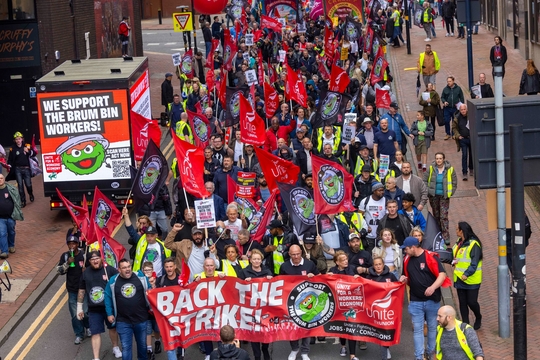
The first Combines were created straight after Graham’ election. A Bus Combine was set up and given support by staff from the Organising Department to drive it forward. Reps from the same companies but different locations met to compare wages and conditions. Experienced research staff within Unite put together information about the huge profits being extracted by bus companies. This led to a significant amount of agitation as reps realised that companies pleading poverty during pay negotiations were in reality making a killing; other workers in e.g. Stagecoach realised the same company was paying them significantly lower wages compared to their Stagecoach colleagues down the road.
This information sharing and agitation resulted in a number of significant strikes. An Abellio bus strike in London - involving 1,800 members - lasted for 20 days and won an 18% pay increase in February 2023. Membership doubled from 900 at the start of the dispute. Similar strikes led to significant pay rises elsewhere in Arriva North West (11.1%), Arriva Yorkshire (9%), Stagecoach Guildford (12.57%) and Stagecoach Aldershot (13%).
Reps told us about bold plans put in place to coordinate pay negotiations and disputes across entire companies and not just at a regional level. This had huge potential: imagine a bus strike in a big city like London where workers across all the bus companies have coordinated their strikes to coincide. Rather than the current situation where, for example, Go Ahead workers are on strike on one route but First Bus workers on a similar route are not part of the strike and therefore not able to take part.
However, as we discuss below, the bus combine inevitably ran up against opposition by the established conservative forces within Unite. In the face of this opposition, the General Secretary backed down and the combine was effectively ended: we didn’t hear from anyone we reached out to that it is still active. The situation within the bus sector in Unite seems to have largely reverted to the status quo prior to Graham’s election: fragmented bargaining with no wider strategy, coordination or direction.
The combines still up and running are: the Finance Combine; the Ground Services Combine; and the Health Combine.
Unite is now a union that strikes more, and wins more. We estimate that spending on strike pay has increased to over £50 million in just over 4 years of Graham’s leadership. This compares to a yearly spend of around £1m prior to Graham’s election. Unite is therefore paying at least 13 times as much strike pay every year as it did previously. According to Graham’s figures, between Aug 2021- Dec 2025, more than 1,500 disputes have occurred and 83% of disputes have been won, totalling an additional £620 million in members’ pockets.
Graham claims that catastrophic membership decline has been halted. A 2024 Unite publication states that ‘for the first time since its foundation in 2007, Unite has recorded membership growth in back-to-back quarters. In fact, Unite’s membership grew in six consecutive quarters between Q3 2022 and
Q4 2023’. However, we could not find any further updates on membership figures published since then, so it is possible membership has declined again since 2024.
What difficulties have there been?
In short, our conclusion is that Graham has not fully taken on the established powers within the union. Unite continues to be a union defined by employer partnership. She has not removed or disciplined National Officers or Regional Officers who are hostile to militant trade unionism. We heard from multiple sectors and regions that these Officers continue to undermine democracy, work closely with employers, suppress workplace action and activity, and have intervened at crucial moments in disputes to collapse strikes (for example by having off-the-record conversations with management, forcing members to vote on bad offers, and pressuring reps to accept unpopular deals). These Officers have enormous influence within Unite on their sectors. They remain wedded to working in partnership with employers and hate militant trade unionism and actively work against it. Despite this, key Regional and National Officers have not been removed from powerful positions, even though it is within the General Secretary’s powers to do so. Many of those we reached out to agreed that the initial fear of a ruthless new GS has all but disappeared.
The Shop Steward Combines have not received the backing they require - and seem to still exist in only three out of Unite’s 20 sectors. By their nature, Combines run up against the established bureaucracy of the union. When working well, they lead to confrontational workplace action. However, this also means they clash with Officers, convenors and elected members in sector committees who oppose militant trade unionism. Some Officers have continually worked to undermine the Combines wherever they can and seem to have faced no consequences. Initial strides forward - as demonstrated by the Bus Combine - seem to have ground to a halt.
An organised rank and file grouping has not emerged to more deeply embed the vision outlined in Sharon Graham’s manifesto. Unite Broad Left was established in the wake of Graham’s victory. The aim was to connect and build up rank and file support for Graham’s agenda so that her manifesto could be implemented in full - for example by running candidates for the Executive Council who would support her manifesto commitments. However, this faction was never really able to build on its initial ambitions. And Sharon Graham has not actively attempted to engage this group in order to create a reciprocal connection between a rank and file base and an insurgent leader. Instead, she has more often relied on staff members to carry out her vision. This approach has obvious limitations and as a result, there is no powerful rank and file group capable of fully supporting the vision she laid out.
Everyone we spoke to agreed that education in the union remains a huge missed opportunity. Unite’s standard ‘Reps 1A Training’ is the baseline training for all reps and it takes five days to complete. However, all training is the same as it has been in the past. There is an overwhelming focus on servicing and individual casework, limited training on workplace organising, and almost zero political education. Those five days are a unique opportunity to grab hold of thousands of union activists every year and turn them into committed militants for life. It is a great shame and an enormous wasted opportunity that the rep training has remained the same.
What lessons can be taken for Andrea Egan from Unite?
-
Egan needs to come in with a plan to set about changes immediately. The first six months are crucial. Factional enemies are on the back foot and don’t know what to expect. They should be moved into less important positions or sacked, and replaced with people committed to a transformative vision of a militant trade union.
-
Andrea Egan should focus on building a wide team of people who share her political and industrial vision. These people should be hard working and reflect regularly on strategy, while being committed to her manifesto. The culture around Egan should be one of critical support focused on building a fighting union for members. It is crucial she avoids creating a culture of patronage, secrecy, and factional paranoia that plagues British trade unions and creates a ‘bunker mentality’ and closed leadership group. Work together with all sorts of roles within the union to talk to them, understand challenges and how you can work together to overcome them.
-
Build a connection to the rank and file capable of supporting the vision locally. As Graham’s General Secretary Hotline showed, accountability measures work best when members are given the opportunity to report union staffers and convenors for underhand and undemocratic behaviour. Accountability should be a dual mechanism from the bottom up and top down.
-
An increase in strike activity leads to an increase in recruitment and expands the horizons of what can be won with members. Unions that organise and fight are unions that grow and win.
-
Strike funds are vital in giving workers the ability to go on strike and stay out on strike for the length of time needed to force the employer to make concessions. Graham’s commitment to spending significant sums on strike pay has been essential in enabling large numbers of workers to take weeks - not just symbolic days - of strike action to win real improvements to their working lives.
-
Combines work when they are given freedom and support to do so. Combines, or any new structures in the union intended to circumvent bureaucratic blocks, will require the full backing of the General Secretary. Without that backing, those structures will run up against the resistance of factional enemies - both elected members and staffers. The General Secretary needs to remove or discipline those who stand in the way of Combines (or other newly established structures) moving workers into struggle.
author
Unite the Union Activists
Subscribe to Notes from Below
Subscribe now to Notes from Below, and get our print issues sent to your front door three times a year. For every subscriber, we’re also able to print a load of free copies to hand out in workplaces, neighbourhoods, prisons and picket lines. Can you subscribe now and support us in spreading Marxist ideas in the workplace?
Read next
Syndicalism and the New Limits of Trade Unions
by
Roberto Mozzachiodi,
Matthew
/
Dec. 28, 2023