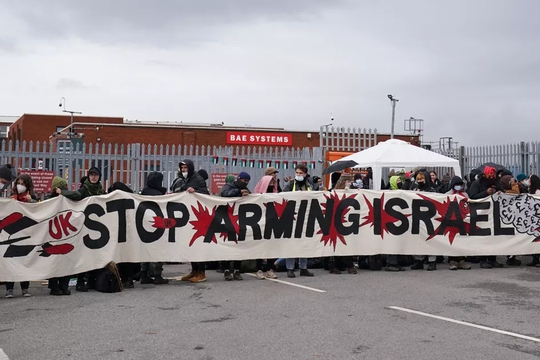
Turning the Tide: Organising Against Militarism in Schools
by
Disarm Education
March 13, 2026
Featured in Class Dismissed: Against The State of Education (#26)
An education worker and member of Disarm Education lays out the reasoning behind and history of their campaign.

inquiry
Turning the Tide: Organising Against Militarism in Schools
by
Disarm Education
/
March 13, 2026
in
Class Dismissed: Against The State of Education
(#26)
An education worker and member of Disarm Education lays out the reasoning behind and history of their campaign.
What is Disarm Education?
Disarm Education is a grassroots campaign by educators, students, and parents to stop the collaboration between schools and colleges with arms companies and weapons manufacturers. We firmly believe that students and young people should not be exposed to the production of war and violence should not be normalised through education.
The campaign has two simple demands. That it is the duty of students, educators, and parents everywhere to resist the normalisation of war machinery in our places of work and education by:
- Uncovering the ties between schools/colleges and arms companies
- Establishing agreements in schools/colleges to prohibit or end any partnerships with companies producing arms.
The campaign follows a strategy of targeted boycotting by specifically schools/colleges to end ties with the 30 arms companies that currently have UK operations (beyond marketing and civilian industries), found using the 2022 SIPRI Arms Industry Database. This means seizing to advertise or promote work experience, apprenticeship and careers opportunities, not inviting arms companies in to deliver workshops/talks/assemblies, disinviting arms companies from careers roadshows, ending both financial and non-financial sponsorships, and not using materials or resources produced by arms companies.
Over the last three years, we have seen war proliferate globally. In Palestine, an active genocide is taking place following 78 years of systematic ethnic cleansing. In Sudan, a counter-revolutionary war fuelled by the global arms trade has led to as many as 400,000 being killed, with the scale of human destruction so great that in El Fasher city the bloodshed could even be seen from aerial satellite imagery. And in Ukraine, we have seen the expansion of NATO’s military presence come to heads with the Russian invasion, with an estimated 1.5 million casualties as a result of the endless military proliferation.
Where there is war, weapons manufactured and sold by Britain are present. The loss of human life and the destruction of the social fabric caused by war only brings an endless supply of profit to weapons manufacturers and arms dealers. Revenues from arms sales and military services by the 100 largest companies globally reached $632 billion in 2023, yet another increase from the year before. The endless cycle of war is systematically encouraged by these merchants of death.
The campaign was born in response to a call from 30 Palestinian trade unions in late 2023 for global trade unions in relevant industries to:
1. Refuse to build weapons destined for Israel
2. Refuse to transport weapons to Israel
3. Pass motions to this effect
4. Take action against complicit institutions and pressure governments to stop all military trade with Israel.
As educators and trade unionists organising in the NEU, we recognised that the call was supported by the NEU’s sister unions: the Palestinian General Federation of Trade Unions (PGFTU) and the Union of Kindergartens Workers. This was a direct call on education workers to end the collaboration between their institutions and weapons manufacturers.
We were also moved and inspired by organic student action across the country. As a direct result of school council walkouts in December 2023, Luton Sixth form suspended all ties with Leonardo due to the company’s involvement in the genocide in Gaza. Previously, the company provided work experience and early careers advice to students. In East London, hundreds of students boycotted an assembly delivered by Wes Streeting MP over the Labour Party’s complicity in the genocide. Up and down the country, we have seen students resist the draconian efforts to censor solidarity with Palestine in places of education by wearing keffiyehs, sporting Palestine badges, and demanding that it is discussed in the curriculum. We were also inspired by historical student-led anti-war campaigns, for example, thousands of schoolchildren across Britain organised school walk outs as part of the ‘School Students Against War’coalition in protest of the invasion of Iraq in 2001.
To respond to the call from Palestinian trade unions, we ultimately narrowed the focus of the campaign to focus on ending partnerships and ties with arms companies. This is because schools are essential to normalising the place of arms companies in an increasingly militarised society, and more significantly, necessary for arms companies to keep building their workforce.
In recent years, there has been some success in organising against arms companies at universities. University students have successfully resisted the presence of arms companies at university careers fairs and in 2024, John Healey, the Defence Secretary made a statement reproaching these campaigns for slashing recruitment figures.
However, our campaign recognised that arms companies begin their recruitment offensives much earlier. Careers ‘outreach’ activities begin as early as primary school to entrench pro-militarist values and to normalise these companies as simple career opportunities. Focusing this campaign on ending careers partnerships with arms companies thus has a very material impact. Firstly, it exposes arms companies for what they are: merchants of violence and death rather than engineers and innovators. This weakens their social licence to operate. Secondly, it builds consciousness in educators and in students as the ideological project to normalise war is exposed, forcing us to interrogate what working with these companies ultimately results in. Finally, if enough schools and colleges establish commitments to end working with these companies, we massively reduce their pool of potential future workers.
The British Arms Industry Globally
The past few centuries have seen military technologies produced in the UK used to threaten, hurt, and kill people across the globe by Britain itself and the states we export weapons to. Time and time again, the British military has launched wars encouraged and supplied by the arms industry. The arms industry has close ties to both the British armed forces and the political class. A foundational principle of trade union organisation is internationalism: the idea that an injury to one worker, anywhere in the world, is an injury to all.
Over the last two years, the British arms industry has directly contributed genocide of Palestinians: The entire rear fuselage and tail assembly for every F-35 fighter jet used by Israel is built in Britain through companies such as BAE systems, Leonardo and Martin-Baker. Elsewhere in Britain, Raytheon and Lockheed Martin develop munitions used to decimate Palestinian life into oblivion, all for the benefit of their shareholders’ pockets. Since 2008, Britain has licensed £560 million worth of arms exports to Israel.The full scale of military production is even higher, due to the ‘open’ nature of many export licenses.
The British arms industry’s contribution to the genocide in Palestine is part of a longer history of involvement in global violence and conflict. This is a continuation of the logic that meant British weapons, equipment, and logistical support was supplied throughout the wars in Iraq and Afghanistan; the BAE tanks and jets sent to the Indonesian government in the East Timor genocide; and the British aircraft, bombs and missiles sold to the Saudi-led coalition that has killed an estimated 377,000 people in Yemen. In Sudan, as the Sudanese Armed Forces (SAF) and the Rapid Support Forces (RSF) commit human atrocities on a mass scale, British arms companies cash in through supplying weapons that are exported via Saudi Arabia and the UAE.
As trade unionists and workers living and working in a country that for centuries colonised, pillaged, and murdered people across the world, we have a responsibility to fight against global injustice. Dismantling the British arms industry is core to bringing down the systems of global inequalities constructed through European colonialism and imperialism. Central to this is weakening a social licence to operate partly constructed by partnerships with schools and the recruitment of students.
The Arms Industry in Schools and Colleges
A key demand of the campaign is to uncover ties between places of education and arms companies. We have sent freedom of information requests to over 16,000 schools across England. While the full extent of the relationship between schools and colleges is still being uncovered, from the initial research two key themes emerge.
First, British schools and colleges have been pushed into these partnerships after decades of underfunding of the education system. Schools and colleges have been forced to collaborate with private businesses to fund the curriculum and maintain resources. These businesses in turn have had unprecedented control of curricula, pedagogy, and governance structures. In a capitalist system, the role of education transforms from a means to instill young people with the pursuit of knowledge to instead producing the future workforce. Places of education also directly reinforce dominant ideologies, values, and beliefs. In this case, the partnership between schools and arms companies reinforces the state’s production of war and violence.
Second, for arms companies, places of education are a means to recruit and shape the workforce. Early recruitment initiatives allow arms companies to mould the qualities they want to see in their future workplace. The diversification of manufacturing portfolios by arms companies obscures their central function, the manufacturing of weapons, used to kill millions of people across the globe. Partnerships in schools and colleges orientated around STEM gives these companies legitimacy, a way of cleaning up their image and positioning themselves as world leaders of engineering and technology.
To illustrate this, we can consider a company like BAE Systems. BAE collaborates extensively with UK schools and post-16 institutions. On its own website, BAE boasts spending approximately £100m in education, skills and early careers activities in Britain annually. The centre point of this is the ‘STEM Roadshow,’ supported by the Royal Navy and Royal Air Force, which has led to 5,000 school visits, reaching over 1.3 million pupils.
In these career roadshows, companies like BAE demonstrate advanced technologies to entice students while obscuring their central function. For example, the theme of this year’s STEM roadshow is Artificial Intelligence, where pupils made songs and music videos with a robot dog called Lexi. This doesn’t show students how these robot dogs are currently being used in the battlefield.
Companies also focus on topics such as space, electricity, robotics, computing and coding while not necessarily revealing how these same technologies are used to manufacture weapons. In 2025, BAE announced £3.5m in funding to continue the programme for a further five years. BAE employees sit on a number of governing boards across schools in Cumbria, and in 2015 it became the non-financial sponsor of Furness Academy in 2015. Senior BAE employees maintain two positions on the school’s governing body.
Another example is Babcock International Group. They are the 38th largest arms company in the world, with 74% revenues coming from arms. The company has partnerships with Israel Aerospace Industries Ltd, a state-owned aerospace manufacturer that supplies the Israeli military. Babcock Learning and Development Partnership was formed in 2012 and ran for 10 years as an agreement between Devon Country Council and Babcock to provide school support services, including attendance monitoring and pupil assessment. They also provided a range of education services, resources, training, conferences and online learning. In addition, Babcock has a team of over 100 STEM Ambassadors who work with local schools and colleges, as well as work experience and apprenticeship programmes, who by their own claims have reached over 30,000 students in the UK.
A final illustration of the nature of the relationship between the arms companies and schools comes from Lockheed Martin, the principal contractor for the F-35 aircraft. In 2022, Lockheed Martin announced a £600,000 “skills development deal” for educational institutes in the North East of England alone. Perhaps even more perversely, in 2023 it produced activity packs for British STEM week which included a colouring in exercise of an F-35 fighter jet, aimed for primary age students.
Alternatives to the Arms Industry
Two common arguments that we encounter in the campaign is that 1) arms companies provide career opportunities to students and 2) we need these companies to sponsor a declining STEM education.
On the first argument, fundamentally, we believe that every child should be entitled to a life of learning, dignity, and freedom, wherever they are born. Opportunities for one group of students here in Britain should not come at the expense of the deprivation and destruction of the opportunities and lives of young people across the world, which the arms trade is responsible for.
Militarisation is damaging the futures of all students, not just the young people growing up in conflict zones where military equipment is being deployed, but also in our own communities across the UK. It locks us into cycles of conflict and compromises our ability to address pressing global challenges, like climate change and widening social inequality. It diverts funds away from social goods, whilst directly contributing to the climate and ecological crises that will define the rest of our young peoples’ lives. We know that military jobs have a lower economic multiplier effect than other forms of investment into public infrastructure such as rail and healthcare.
An alternative to the militarisation of our economy is a ‘just transition’ programme. The same STEM skills that weapons manufacturers desire are needed in a hugely increasing industry: renewable energy. As far back as 1975, workers at the Lucas Aerospace company proposed that their skills in weapons manufacturing be used for ‘socially conscious’ manufacturing, such as medical equipment and renewable energy. Since then, many former weapons manufacturers have transitioned to creating items for civilian use, including sustainable energy. In 2014, 16,000 in the UK were employed in offshore wind energy: in 2025, that number sits at around 55,000 - an increase of almost 250%.
On the second argument, we recognise that there is a crisis in STEM education. In Britain, there is a chronic shortage of STEM teachers. The most recent recruitment statistics show only 63% of the recruitment targets for Maths teachers were met, going down to 36% in Computing and 17% in Physics. There is also a shortage of 150,000 STEM researchers and technicians which comes at an estimated cost to the UK economy of £1.5bn. Despite recommendations from the Institution of Engineering and Technology (IET) to address this shortfall, by “increased funding for the further education sector, with a focus on supporting infrastructure and teaching”, we have seen a sharp decline in funding for the FE sector.
The defunding of STEM education is a part of a broader picture of education cuts. Cuts to education funding in 2026 are the equivalent of salaries for 12,400 school staff, or 5,700 teachers and 6,700 support staff. The gap in government funding means that 75% of schools will be forced to make cuts next year.
The crisis in STEM education can’t be mitigated by a few arms companies. As the Stop School Cuts campaign demonstrates, we need to restore 14 years of funding cuts to education to see better teacher retention, improved classroom sizes and better outcomes for students across the country. We can’t rely on unaccountable arms companies to replace the role of government in providing a fully funded STEM education for our students. Giving arms companies this role means that we remove accountability and transparency from the curriculum whilst giving these merchants of death the power to shape teaching and learning to fit their workforce needs.
Organising so far
In April 2025, the NEU voted to affiliate to the campaign in its national conference. This means the largest teaching union in Europe voted to campaign against the militarisation of our schools and colleges. To achieve this, we passed affiliation motions at supportive districts in Hackney, Waltham Forest and Oxfordshire where there was already a strong organising presence. The NEU is mostly organised through “districts”, so to prepare for the vote, we began to develop a presence at this level, through speaking at branch meetings, joining the trade union block at national Palestine demos, collaborating with other left NEU groups, and hosting an organising workshop prior to the conference vote.
To develop the campaign nationally, we have now shifted our focus to developing the campaign in districts and workplaces while continuing to host workshops and meetings at national conferences and events. Since April, 15 districts across the country have voted to affiliate to the campaign. Affiliating allows the campaign to provide workplace reps with organising resources and training, as well as gives workplace reps the support to build the campaign more locally.
Passing district affiliations gives workplace reps organising support and cover. We have already seen success in this strategy in a school in Manchester where an organiser took the campaign to their workplace. The NEU committee in this workplace ran a termly workshop for members on political issues affecting education broadly, and following the national affiliation, they held a workshop on the increased presence of arms companies in schools. The organisers promoted the meeting across the school and included a survey to gauge members opinions on arms companies and tangentially the armed forces in schools. The meeting had a positive turnout with some members attending their first ever union meeting. This resulted in the workplace branch affiliating to the campaign, meaning that reps and the members will now organise towards getting the school to commit to being free from arms companies.
Practical steps to organise institutions to commit to being free from arms companies will depend on their context. In regions where arms companies have minimal presence, reps could work with members to create open letters and petitions to their senior leadership teams to break ties - this was successful in the aforementioned school in Manchester, where 50 staff members signed an open letter to cancel a workshop hosted by the RAF. In regions where there is political support for anti-war causes such as the genocide in Palestine, reps may work with local solidarity groups and parents to build leverage to end these ties. Where arms companies have a strong presence, a longer-term strategy will be required with cross-union liaison and worker outreach to push for a worker-led just transition programme - some of this work has already begun with campaign groups such as Workers for a Free Palestine.
The key to developing this campaign in workplaces is by building union strength more generally. Regular workplace meetings which engage members on issues linking pay and conditions to broader political struggle will be integral in demonstrating the relationship between inequalities in the workplace and global injustice. Success of the campaign will rely on SLT and governors deciding to not work with these arms companies anymore: strength and leverage relies on members collectively organising for this, with the support of students, teachers and the wider community behind them.
The current Labour government is using imperialism abroad alongside inciting increased nationalism at home to secure the interests and profits of arms companies at record levels, while the working class are faced with stagnating wages and degraded standards of living. The demand to divest from supporting endless wars abroad, or the production of weapons used to drive war, is in direct relationship to the demand for better working and living conditions. Between 2022 and 2023, major strike action led by education workers across Britain led to a revised pay offer by the government, demonstrating that industrial strength is a driving factor in winning economic demands. Beyond the confines of a single institution, education workers make up about 27% of the public sector workforce - this industrial base has the power to demand a redistribution away from increased militarism to investment in the public sector. Likewise, the anti-war movement in the last two years, has mobilised millions of people across Britain to take political action and it is the work of each trade union organiser to draw this section of the working class into our unions. Strengthening an internationalist position in our trade union organization will be fundamental to developing working class organisation by building positive power - the role of trade unions thus is not confined to dealing with grievances and managing disputes but rather to build working class self-governance both domestically and abroad.
The Path for a Demilitarised Education
So far, the campaign has focused on developing in NEU districts and workplaces. Beyond affiliation, rank-and-file workers will need to develop worker committees and develop density of support in their workplaces to push institutions to end ties. As workers in the Lucas Aerospace combine pushed for alternatives to arms production, these workers committees need to demonstrate viable alternatives to collaborating with arms companies - this includes campaigning on both a national level for better funding of STEM education, and on a local level of working with organisations that don’t harm people and the planet. This will be integral to ensuring that there is an industrial base for the campaign and that there is a material focus driving the campaign forward.
To develop this into a mass campaign, alongside developing in our workplaces, we will now need to turn our attention to engaging parents and students. We have already seen organic support amongst community organisers to boycott arms companies in schools. For example, Hastings and District Palestine Solidarity Campaign launched a ‘Schools Out for General ‘Genocide’ Dynamics’ campaign to give parents, careers, and students tools and resources to demand their schools stops hosting the arms company in East Sussex. Connecting workplace-level organisations with local internationalist ones, such as PSC branches, will be integral to developing the campaign amongst parents and students. This will provide important leverage to the campaign when taking the demands to SLT and governors.
A key challenge for the campaign will be passing this in workplaces which are heavily reliant on subsidies or support from arms companies. This is regionally concentrated in areas where the arms industry has a heavy presence, for example, Barrow-in-Furness in Cumbria. To address this, we know we need to have a dual strategy of developing industrial strength within the NEU whilst also supporting arms workers organising against arms manufacturing within their own unions. We can do this through worker outreach and supporting internal efforts to push for arms conversion.
We recognise that this campaign will not be easily won without an alternative to the increasing militarisation of our society. A joint trade union and political approach will be necessary to curtail the subsidisation of the arms industry, at the expense of social welfare and investment into public infrastructure. Industrially, we need to win the argument that cuts to funding for health, education, transport is a political decision which prioritises warfare over welfare. The primary setting where we can do this is in our workplaces and trade unions.
We have already seen wins in schools and colleges across the country. The tide is turning against never ending war and ever increasing militarisation. If we have 1, 10, 100, or 1000 fewer workers working on arms manufacturing then that is a victory for the campaign. As educators and trade unionists, we believe that education should create a space which allows collective liberation to flourish. Schools and colleges should be spaces of critical thought and creative collaboration. A space for educators and students to raise collective consciousness together, to challenge injustice, and to build an imagination of a better world for all.
author
Disarm Education
Subscribe to Notes from Below
Subscribe now to Notes from Below, and get our print issues sent to your front door three times a year. For every subscriber, we’re also able to print a load of free copies to hand out in workplaces, neighbourhoods, prisons and picket lines. Can you subscribe now and support us in spreading Marxist ideas in the workplace?
Read next