Six days in Turkey between the March protests and Mayday #1

inquiry
Six days in Turkey between the March protests and Mayday #1
by
Connor Cameron
/
Jan. 12, 2026
Part 1
London-based shop steward Connor Cameron traveled to Turkey last year to visit some of our contacts after the outbreak of the March protests. Here is the start of a three part journal from his trip.
Saturday, April 19 2025
I wake up groggily to the sound of a cleaner rattling off machine gun fire on his phone on the bench behind me. I roll over and squint through the airport’s vast glass-panel windows. The weather’s shite.
I climb stiffly off the bench and make my way down through passport control and into the metro. I landed around 4 am and spent the last few hours trying to catch up on sleep in the arrivals hall. Screens on the metro play dramatic drone footage of newly constructed transport infrastructure. Cabinet ministers cut ribbons in golden hour light. Paternal. Benevolent looking. Passengers sit below scrolling disinterestedly on their phones. Turkey’s ruling Justice and Development Party (AKP) have spent the last twenty years fuelling sugar rush economic growth with cheap debt and market liberalisation, but now the crash has arrived, as sure as night follows day, and the country is once again on the barricades.
It’s about four weeks since nationwide protests broke out in response to the arrest and imprisonment of the country’s main opposition leader, Ekrem İmamoğlu. İmamoğlu’s arrest, however, was only the catalyst for the protests. They’ve been propelled by much broader social grievances. The AKP’s development strategy has begun to pull apart at the seams. Debt-fuelled construction programmes have given way to hyperinflation and unemployment. Young people see their futures disappear while pensioners, the bedrock of the AKP’s traditional base, have little left to show for their pasts. The drastic immiseration of Turkish society has made these protests the most intense and far-reaching since the Gezi Park protests a decade ago. This time, however, Erdoğan can no longer rely on “his 50%” of the people.1
It’s still overcast when I arrive in Beyoğlu, one of Istanbul’s several city centres. I drop my bag at a shitty hostel near Taksim Square and meet Saruhan, a 25-year old lawyer and member of a local communist group. He’s wearing a light jacket and shakes my hand formally before leading us off through the side streets of Istiklal Caddesi - Istanbul’s main high street. We take seats at an alleyway cafe and are joined by Ayse, a freelance videographer in her early 30s. They’re both members of Umut Sen, a communist group active in Turkey’s independent labour movement. They tell me that Turkey’s three main union confederations - TÜRK-İŞ (~1.75 million members), HAK-İŞ (~680,000 members), and DİSK (~327,000 members) - are the home of collaborationist ‘yellow unions’, and that it’s only been with the relatively recent growth of smaller, independent unions that the Turkish workers’ movement has finally seen a revival of more militant and less domesticated forms of workplace conflict. Over the next week, their group will introduce me to this side of Turkey’s working class movement.
We drink tea, and I ask about the protests. This time, unlike Gezi, which was led by the left, the protests have been dominated politically by the Republican People’s Party (CHP), the party of the arrested İmamoğlu. The CHP are Turkey’s main opposition party - secular nationalist as opposed to religious nationalist, centre-left as opposed to centre-right. The scale and support for the protests has caught the government off guard and Erdoğan, not sure of how to act, has retreated into his palace to consider his options. By Turkish standards, the repression so far has been mild. Beatings, still. And tear gas. And pepper spray. Rubber bullets. Injuries. Thousands detained.
We finish our drinks and snake our way through more alleyways to meet up with Görkem and Bashahar, two other members of the group. We order another round of sage tea and coffee and sit beside white-haired men playing backgammon. Tonight there’ll be a Palestine protest on Istiklal Caddesi led by the CHP. Despite not having been traditionally aligned with the Palestine movement, the secular opposition has identified an opportunity to discredit the government - which professes support for Palestine yet continues to trade with Israel. Someone tells me Palestine is society’s soft spot. It makes it possible to continue the anti-government protests in an acceptable form. Everything else is banned.
Later on, I try to join the protest, but Istiklal has been completely closed off by the police. The metro stations are shut and each route onto the shopping strip is blocked by tanks and armoured police. I’m amazed by how many there are. I wonder how much it costs the state (and economy) to sustain such a force. Saruhan sends me a Twitter video of some kettled students chanting somewhere further up the street.
I meet a couple later at a techno club, one Nigerian, one Belgian, who tell me life is getting harder here, and they, like many others, are trying to find a way to get out. Still, they tell me, they feel sorry for me living in Britain - what a truly depressing place. Some young medical students, dancing harder than anyone else in the sweaty, low-ceilinged basement, share their thoughts on the country’s lingering attachment to its ruler. War is close here in Turkey, and the region is volatile. Erdoğan seems to have finally ‘won’ in Syria and is one of the only figures on the world stage who can meet with both Zelensky and Putin. A recent video of Macron ‘begging’ him to do the right thing makes him stand like a lord over Europe. Erdoğan may have lost the people’s love, but they’re still afraid to live without him.
Sunday, April 20 2025
It takes us two hours by public transport to get from Beyoğlu to Beylikdüzü, a working class district on Istanbul’s western outskirts.
We’re here to see a play organised by DGD-SEN, an independent warehouse workers’ union. The organisation was founded in 2013 as a breakaway from the larger Liman-İş union (affiliated to HAK-İŞ) after officials from the latter collaborated with managers to sack workers who’d initiated an organising drive at a Migros warehouse. The sacked workers reconstituted themselves as the new union and have since established themselves through protests, direct action, and wildcat strikes as the by far most militant workers’ organisation in the sector.2
This, however, has not been easy. In order to be recognised for collective bargaining - and by extension legal industrial action - Turkish unions must pass a series of restrictive membership thresholds. A union must organise 50% +1 of the workers in a workplace, or 40% +1 if the firm has multiple sites. More problematically, the union must also organise at least 1% of the workers in that workplace’s legally determined ‘industrial classification’. Turkish labour law recognises twenty of these classifications, which range from employing about 95,000 workers up to 4 million. In the large classifications, these thresholds effectively lock out most independent unions from recognition.
In response, DGD-SEN have found ways to largely circumvent formal disputes, relying more on their strength of organisation than legal entitlements. In 2013, they won compensation for victimised members at a major Migros distribution centre through a protest campaign, and the same again at the same distribution centre four years later. When inflation tore through the Turkish economy in 2022, their militant organisational culture enabled them to wage an extremely high-profile wildcat strike and win a 70% pay rise for members - despite being officially locked out of legal collective bargaining arrangements.
Organising and working in the sector is difficult, though. The majority of workers are either recent graduates, who don’t expect to stay there long, or no-longer-recent graduates, saddled with credit card and mortgage debt and terrified of losing their jobs. Workers in the warehouses are pressured to work 24 or even 36-hour shifts. No one likes to admit it, but drugs make it possible.
In the neighbourhood, meanwhile, everyone is a migrant, either from within Turkey or elsewhere in the region. Currently, more than 3 million Syrians live in Turkey, and it’s increasingly common to meet migrants from Africa and Central Asia. These districts themselves didn’t even exist fifteen or twenty years ago. Rows and rows of densely packed tower blocks blanket the hills fanning out from the city, punctuated occasionally by minaret towers or motorway flyovers. Even internal migrants from the same regions cluster together in the same neighbourhoods. “It’s as if everyone from Colchester who moved to London lived in the same area,” I’m told.
We eat cheap pilau from plastic trays at a busy interchange by the side of the motorway. Workers stream in and out of a massive commercial park beside us. Then we catch our third bus of the day, on to the play.
It’s being held in a school hall on the very edge of the city. At first, the turnout is low, and I feel a pang of sympathy for - and identification with - the organisers. We’ve all been there at some point. It’s hard to find venues in the workers’ own neighbourhoods, and besides, their infernal shift patterns make it hard to find a time when everyone’s available. A group of striking construction workers have come to show their solidarity, though. They’re mostly young, in their twenties, wearing dusty jackets and seem friendly but slightly uncomfortable. They take shelter from their awkwardness by sticking tightly together, smoking cigarettes, telling jokes and watching kids play football behind a chain-link fence.
We drink tea and smoke cigarettes at a nearby cafe before heading into our seats. The play’s called Bir 80’ler Hikayesi (A Story of the 80s). It’s an autobiographical comedy, mainly a one-man show, about an actor who was tortured by the military for a poem he wrote after the coup at the start of the ‘80s. The play opens with a woman performing ‘80s pop songs on a violin. The audience sings along enthusiastically before the lead gets started on a one-and-a-half hour comedy reenactment of military torture. It’s quite strange, and I don’t understand a word, so I don’t understand if it’s funny or not, although the audience mostly laughs along. At one point, a group of workers are led up onto the stage, and one is encouraged to take his shirt off while the others laugh and record it on their phones. I sleep a bit and watch the audience.
I’m glad because, eventually, more workers do turn up once the show is already well underway, and, in the end, the organisers are pleased with the turnout. As the show ends, the workers give the lead performer a bouquet of flowers, which he then throws back to the audience. One of the warehouse workers leaps up and pushes his way through the crowd to dive for the flowers. He catches it with satisfaction and immediately spins on his heel and heads over to the construction workers. He hands the flowers over with a smile and clasps one of them in a hug. He thanks them for coming and makes a short speech expressing support for their strike. The construction workers express their thanks in turn, then pass the bouquet on to one of the warehouse workers’ kids.
On the long journey back to Beyoğlu, Ayse explains that Umut Sen and the unions close to them spend a lot of time organising social events and deepening their friendships with each other. “If you only call people once a year to invite them to Taksim Square for mayday, or to a conference or protest - then no one will come. You need to spend time with people. Make happy memories together. Become friends.”
Not long before our second bus gets us back to the metro, she gestures out of the window. We’re passing one of Istanbul’s newly founded municipal restaurants. They were recently opened by İmamoğlu and have been extremely popular. There are ten across the city offering heavily discounted meals. It’s mostly pensioners that eat there, Ayse explains, because they’re the only ones with the time to wait in the queues.
Monday, April 21 2025
I wake up late and read in Gezi Park. The last time I was here was just before the protests a decade ago. Back then, it really did feel like the city was about to explode. I’ve never felt anything like that before. You could genuinely feel the tension in the air. This time, the park’s occupied by a police camp watching over the square.
Ever since Gezi Park, mayday assemblies in Taksim have been banned. Each year, the communist groups dutifully delegate a handful of members to try and push their way in and get ritually arrested. They get detained for a day or so, and then eventually released. But this year the situation’s different. The recent upheaval has put a lot more at stake. The first wave of street fighting may be over, but the atmosphere of possibility isn’t yet gone, and people are still just waiting to see what happens next. The scale and extent of anti-government anger make the situation more unpredictable than usual ,and defeating the government on mayday at Taksim would be a massive victory, as well as having the potential to establish some kind of class orientation to the protests. Umut Sen throw everything into mobilising for Taksim on mayday.
The rest of the labour movement is being more cautious, however. The students have called on DISK - “The Confederation of Revolutionary Trade Unions” - to assemble at Taksim, but they’re so far refusing to risk it. They’ve called for a rally across the Bosphorus, in Kadıköy. The repression may have been relatively mild this time, so far - but no one’s really sure what’s about to happen next.
I meet back up with Görkem for lunch. He’s a lecturer at Istanbul University and talks me through Turkey’s socialist and trade union landscape over kebabs. Our conversation eventually turns back to the protests. He tells me most students at Istanbul University are afraid to protest at the university itself. They’re generally set on domestic careers and don’t want to get identified and blacklisted from (the better-paid, more secure) public sector jobs. They’ll join protests in the city - wearing masks - but lack the confidence to do it in the university itself. Students from the smaller, boutique universities in Galatasaray or Bosphorus, on the other hand, intend to move abroad when they graduate, so they feel that they have less to lose from fucking up their future prospects in Turkey. They have more prominent student organisations and are less likely to be masked at the protests.
We wander through Istanbul’s old town as we talk. By the university. Through the bazaars. Along the outer courtyard of Suleymaniye Mosque. Across the Bosphorus, Görkem points out the glittering towers of one of several financial districts. “If you want to make money on the black market, from the new regime in Syria, that’s where to go. All that illegal, unregulated money is flowing through those towers.”
We eventually settle on little stools outside an alleyway cafe. The side street is lined with dirty white vans and shuttered garages, some bearing real estate signs. Görkem explains that tourism and gentrification are steadily eliminating what’s left of the light manufacturing and logistics units in the old town. I’m mostly surprised that there’s any left at all, only a stone’s throw from the Blue Mosque.
We both need to leave soon, but before that, Görkem shares some final reflections on Turkey’s socialist parties. They’ve been weak for a long time now, he argues, and disconnected from the working class beyond a layer of white-collar workers. Through a regional quirk, they’ve been able to compensate for that weakness. By piggybacking on the Kurdish movement, socialists are able to secure parliamentary seats out of all proportion to their actual political strength. If you can strike a deal with the Kurds and they sponsor you in one of their strongholds, you’re almost guaranteed a seat. Turkish socialists have learned to rely on this, Görkem argues, and aren’t actually addressing their own independent weakness. Umut Sen hold the position that if socialists are to stand any chance of changing Turkish society, they will need to reconnect with the wider working class, not only with white collar workers.
This analysis, but much more so the practice - Umut Sen’s very visible role in Turkey’s militant independent unions - has created internal pressure on larger socialist organisations to adapt. Their members point to Umut Sen and ask why their organisations are not also following suit. Some, like Türkiye İşçi Partisi (The Turkish Workers’ Party), have been gradually placing more emphasis on their ties with organised labour - although Görkem argues that they do this mainly through links to senior officials and not actually through connecting with rank and file workers.
When I ask about the level of debate and exchange between socialist groups, Görkem tells me that the divisions run deep. Members of competing groups literally killed each other back in the ‘70s, armed and funded by competing socialist powers. Those murders have a long-lasting impact. For Umut Sen’s part, they try to have friendly relations with all the groups but don’t see any future for regroupment efforts unless that comes with a change of strategy, and they’re trying to lead by example.
Yesterday, Ayse gave me a slightly different side of things. Beyond the more hardcore cadre that Görkem described, there are also the cafe socialists, who drink tea in the same teahouses and debate and exchange their publications there. There’s a lot of gossip in these environments, and it creates a strong social pressure to maintain solid lines and not do anything politically embarrassing. “Otherwise how could they show their face in the cafes again?”
Tuesday, April 22 2025
I’m meeting up with Ayse again this morning at a worker’s protest in northern Beyoğlu. It’s a relatively unusual case, a white-collar worker from a left-leaning NGO who’s been sacked and now set up a daily protest camp - a traditionally blue-collar means of struggle. When I arrive, I meet Caner, the worker, and Ayse, along with a few other supporters. The group are milling around chatting beside Caner’s colourful protest signs, pinned down from the wind by rocks. We’re just in front of a memorial plaque commemorating the 2007 assassination of Hrant Dink, a Turkish-Armenian journalist and the NGO’s namesake. Caner was originally protesting outside the Hrant Dink Foundation’s offices, but the police drove him off and told him not to come back. They’re expecting the police to crack down on him here, too, but so far, there’s no sign of them.3
I’m told that the foundation is notorious for the poor treatment of its workers. Caner explains that he was initially told that he was being sacked due to financial pressures, but when he objected, the foundation retaliated by registering his dismissal as being due to “inappropriate behaviour”. This vague category - which typically involves sexual misconduct or intoxication at work - is visible to prospective employers, a practice which makes it almost impossible to find more work. Caner took the foundation to the labour court, which found in his favour, but they’ve now appealed, dragging the process and Caner’s unemployment out for much longer - potentially for months.
As we talk, I watch purple-uniformed food couriers shunt their way through the traffic on mopeds. Yemek Sepeti branding. And Trendyol. No sign of Deliveroo or Uber. I ask the others about the situation here. They tell me the industry is massively expanding, and there was a big strike against Trendyol a few years ago that won a significant pay rise. I’m reminded of Greece, where a strike against eFood successfully fought off self-employment status around the same time. Both are small firms by international standards, but ones which dominate their domestic markets. “Have you kept in touch with the workers?” I ask. “Here and there,” they reply. “There was a big wildcat strike in London a couple of years ago, maybe you heard about it. We translated its bulletin and gave it out to riders here as a way to rekindle our links.” I laugh in amazement and tell them I’d been involved in the strike and worked on the bulletin. We could barely find enough people to distribute it outside of London, and here they were doing it in Istanbul without us even knowing.4
The conversation turns to mayday. The debate in the movement continues. The Turkish Workers’ Party have apparently gone quiet on their assembly point. They’re under pressure to announce Taksim and don’t want to look weak, but still don’t feel confident enough to risk the repression. I wonder about the gossip in the cafes. Umut Sen will meet tomorrow to discuss their position. The debate has now become the main focus of the left of the protest movement, and no one expects any big mobilisations to happen again before then.
After lunch, I meet back up with Saruhan on the Asian side of the city. The construction workers I met a few days ago have put a call out for support at their picket line. It takes us about an hour to get from the port of Kadıköy down to their little camp in Pendik.
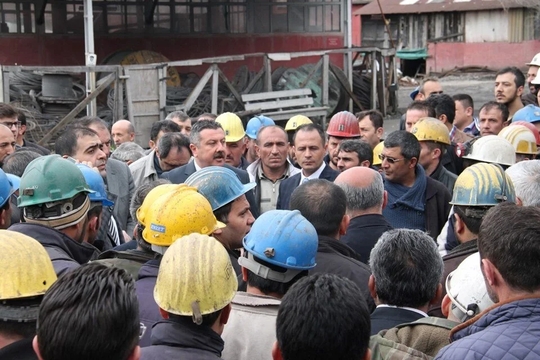
The workers are employed, through seemingly several layers of sub-contracting, on the construction of a hospital on the southeastern outskirts of the city. At some point, their wages stopped coming, so they downed tools and set up an occupation outside the main office of the parent company. The workers have been sleeping there together under a plastic gazebo for a while now, demanding their wages while the construction site stands still. They’re going back into negotiations this afternoon and have called on supporters to rally outside and ramp up the pressure.
When we arrive, about a hundred and fifty people are gathered outside the front of the office, about a third of them cops. The crowd are chanting and giving speeches while waving red flags and homemade banners. Mostly students, with the construction workers milling around together under their tent on the other side of the road. I notice student union signs from Galatasaray and Bosphorus, and smile, remembering Görkem’s comments from the day before.

After the first round of speeches are finished, the whole group settles down for a seated assembly at the construction workers’ tent. The workers and students exchange questions and little speeches, occasionally breaking into spontaneous chants. Both sides look excited for the other to be there, and each regards the other with equal curiosity. Among the students, the women speak more than men, generally chain-smoking as they do.

After a while, we get back up and start chanting again, and then, suddenly, hundreds and hundreds more students appear, arriving in one massive bloc, waving flags and chanting in a single, booming voice. This gets everyone really excited, and the atmosphere is electric. The turnout now well outstrips expectations and the recent norm for this kind of worker-student rally.
Saruhan, generally serious and understated, smiles and turns to me. “It might sound dramatic, but you might be facing a historical moment. A turning point for the Turkish left. People are scared here now. Not just of going to prison, but of dying there, or being killed in the streets. There are worse things out there than the government. There are a lot of rumours about the Islamists returning from Syria with guns and military experience. The situation is serious. And leftists are isolated and know it. They’re slowly realising that they’ve been disconnected from the working class for too long. It’s not a game anymore. But more and more of them are also starting to realise that it’s only by reconnecting with the working class that they stand any chance of saving themselves. The revolutionary generation of the 1970s was born through students meeting workers in the late 1960s. There are no guarantees, but we have to hope this moment can be a turning point for us too.”

I remember the night ferry across the Bosphorus being one of my favourite things about the city the last time I was here, and it’s just as beautiful now as I remember it then. I’m travelling back with another Umut Sen member, an art historian in his twenties or thirties who joined us at the construction workers’ rally. I can’t speak Turkish, and his English is limited, so we take turns passing our phones back and forth, comparing experiences with inflation and the Palestine protests through Google Translate. When we get back to Beyoğlu, he briefly tells me about his time in prison as part of a revolutionary youth group. We exchange good nights, this time with our voices, and I head back to my hostel.
-
‘Recep Tayyip Erdoğan dismisses Turkey protesters as vandals’ https://www.theguardian.com/world/2013/jun/09/recep-tayyip-erdogan-turkey-protesters-looters-vandals ↩
-
For more on the origins and philosophy of DGD-SEN, see ‘2022 Grevleri 3: Migros Esenyurt Depo Grevi’ by Cem Gök https://www.yabankedileri.org/makale/2022-grevleri-3-migros-esenyurt-depo-grevi and ‘Workplace committees are an absolute must’ by Murat Bostancı and Neslihan Acar https://birartibir.org/workplace-committees-are-an-absolute-must/ ↩
-
The attack didn’t come til later, on May 7th, when the little camp was broken up and Caner taken into custody. ↩
-
For more on the Trendyol strike, see ‘Trendyol’ by Umut Sen https://notesfrombelow.org/article/trendyol, for the eFood strike, see ‘How Greek Delivery Riders Are Fighting the Gig Economy’ by Iwan Doherty https://tribunemag.co.uk/2021/10/how-greek-delivery-riders-are-fighting-the-gig-economy, and for the strike in London, see ‘Delivery Strike! Reports from the frontline’ by Rebel Roo https://notesfrombelow.org/article/delivery-strike-reports-frontline. Uber acquired an 85% stake in Trendyol about a month after my visit, driving forward the international consolidation of capital in the sector. ↩
author
Connor Cameron
Subscribe to Notes from Below
Subscribe now to Notes from Below, and get our print issues sent to your front door three times a year. For every subscriber, we’re also able to print a load of free copies to hand out in workplaces, neighbourhoods, prisons and picket lines. Can you subscribe now and support us in spreading Marxist ideas in the workplace?
Read next