Dirty Old Mops: Capital and Inquiry in the Service Sector
by
Achille Marotta
November 17, 2026
Featured in The Work Ahead (#28)
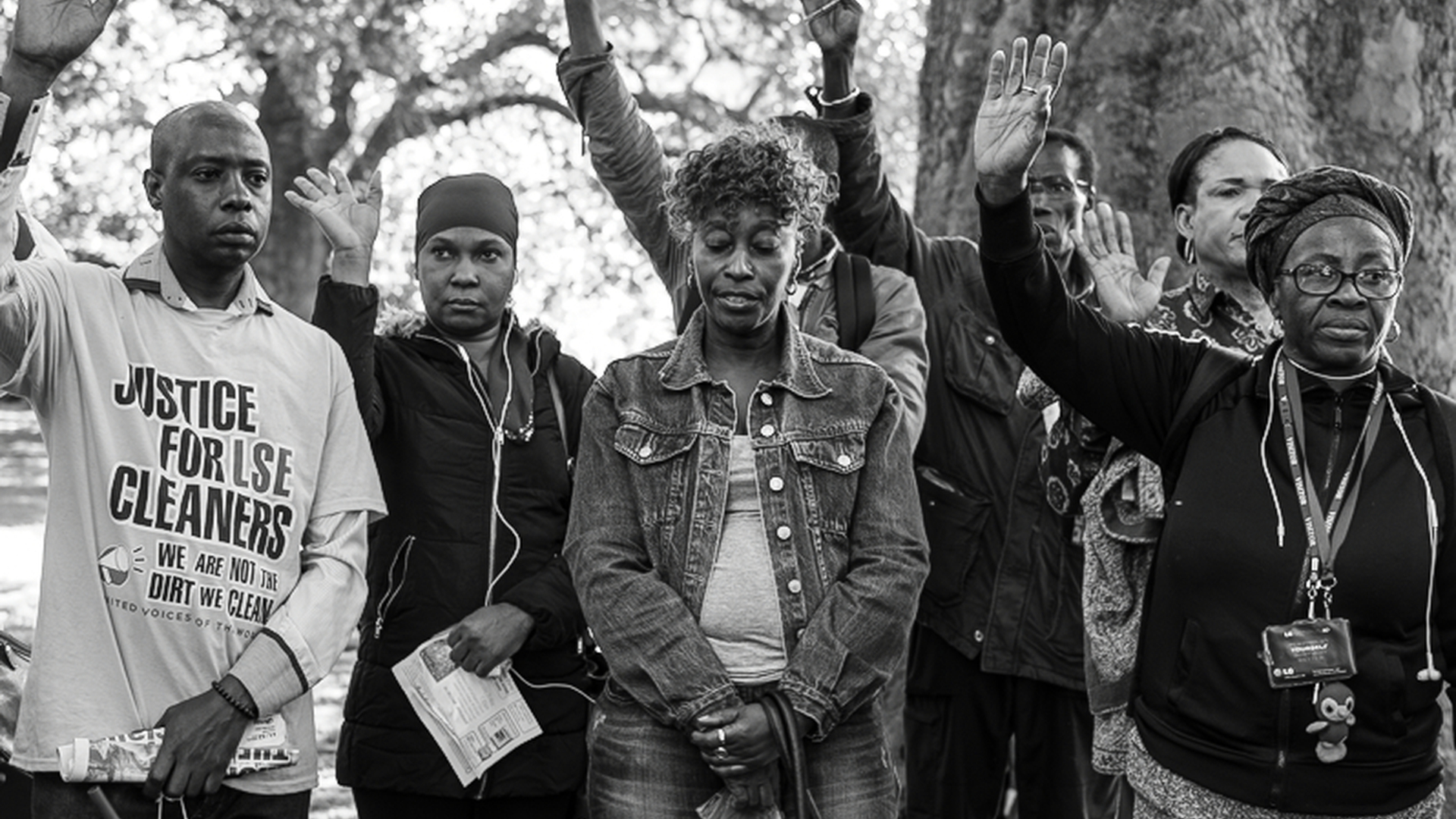
Achille Marotta, who organised in the Justice for Cleaners movement, initiates an analysis of the service sector through the struggles of cleaners in London over the last fifteen years.

theory
Dirty Old Mops: Capital and Inquiry in the Service Sector
by
Achille Marotta
/
Nov. 17, 2026
in
The Work Ahead
(#28)
Achille Marotta, who organised in the Justice for Cleaners movement, initiates an analysis of the service sector through the struggles of cleaners in London over the last fifteen years.
The aim of this piece is to understand the so-called “service sector” by way of the struggles waged by cleaners in London over the past fifteen years. A militant minority in the labour movement in Britain - small grassroots unions - has emerged from migrants employed by private companies subcontracted to clean universities, hospitals, restaurants, hotels, and the high-rise buildings which make up the city’s skyline. While much of this militancy results from the traditions of struggle of the cleaners themselves (what we call their political composition),1 it is also shaped by the peculiar character of cleaning work (technical composition), which are representative of much “service” work today.
To do this, I will focus on Marx’s categories of “variable” and “constant” capital. What is meant by this jargon is the amount of capital that capitalists invest in wages (variable) versus the amount they invest in materials (constant). A sector with a high capital composition, such as the energy industry, is one where a large proportion of capital is constant: machinery, materials, transportation, and so on. A sector with a low capital composition, such as cleaning, is one where the constant capital is limited - the titular dirty old mops.
Variable capital is called variable because it expands during the production process: workers are exploited and therefore make more money for capitalists. Constant capital does not expand; its value is transferred to the final product. For example, if on average a mop ceases to work efficiently after being used to clean 2,000 square metres of space, the value of each sqm cleaned will include 1/2000 of the value of that mop. It does not create new value that wasn’t already in the mop. Thus, capitalists seek to keep using that mop for as long as possible, even if it makes the cleaners’ job more difficult. A cleaner once told me:
The other day a supervisor told me one of these rags should last six months. This is impossible. It gets used to clean every day; at the most it can last two months. And the same with gloves: workers bring them from other jobs, and to clean the floor they just use water. You have to work more, the work is harder. And the same with hoovers, we don’t have enough. We have two or three from the eighties, and you have to share with workmates, you waste so much time.
It is this aspect that I consider representative of the so-called service sector: “You have to work more, the work is harder”. By cutting constant capital, the capitalist further squeezes the worker to produce that value with their own labour. It is a way to impose more work and to produce more profits. You can find this in other cases, such as when your boss in the restaurant refuses to change the cheap blunt knives. Or when food delivery drivers have to buy their own mopeds and smartphones, effectively taking on a wage cut. This also happens in the cleaning sector, where cleaners find themselves bringing their own protective material and tools because of their employer’s cheapness. This is why the messianic ideology of full automation is so dissonant with the daily impression of living in “Shit London”.
Service sector capitalists only invest in one kind of technology: monitoring tools, such as fingerprint scanners used to clock cleaners in and out. This machinery does not replace cleaners themselves, but merely the managerial work that is normally necessary to discipline labour. One company offers GPS-enabled management and monitoring based on workers’ own smartphones. In this way, technological “innovation” in cleaning work follows the same rationality as food delivery platforms, where new tech has not replaced the couriers themselves, but rather the clerical staff who once assigned tasks to workers via radio. Data about workers’ activities becomes instrumental to the interests of the capitalist, who uses it to decide who gets fired and who gets extra shifts. We already live in the high-tech future, and it is a dystopia of surveillance and dirty old mops.
High-tech and low-tech: two sides of the same coin
For the cleaning capitalist, the complaint is that they are forced to pay low wages because clients demand low prices, with other companies always ready to undercut their bids. Clients minimize prices by putting contracts out to tender every few years, creating a race to the bottom and worsening conditions. This is true of private enterprises, such as offices in the City and Canary Wharf, but it is also true of hospitals and universities, where cuts and government-imposed neoliberal policies mean they act like private companies.
At the level of the general market, we have to see service capital as the flipside of high-composition sectors such as the energy industry. On one side, the energy capitalists - such as oil producers - command high prices as tributes from all capitalists and workers, and even call forth wars to protect those tributes. On the other side, service capitalists - such as cleaning subcontractors - are forced to offer low prices, and therefore exploit workers through low wages, making them work harder through old mops and broken buckets. At the level of investment, profit rates tend to equalise, as investors shift their capital to industries that are more competitive. Low-composition sectors such as cleaning require little initial capital, and therefore attract investments. However, this high rate of investment raises competition and supply, thereby lowering prices and profits. On the other hand, capitalists will not invest the high amounts of capital required by highly automated sectors unless they can experience a high rate of profit. The result of all of this is that high-composition sectors sell their products at prices above their value, while low-composition industries sell theirs at prices under their value.2 In a workplace context: an office has to spend more money on heating, and therefore tenders its cleaning contract to a company that offers it for cheaper.
Highly automated industries such as oil and gas, therefore, come hand in hand with the low-tech, tax-dodging, law-breaking Wild West of the service sector. This combination of futuristic machinery and backbreaking dirty work might explain why dystopic science fiction has maintained such a grip on the popular imagination since the 1970s, when automation and services expanded simultaneously. The future is already here, and it looks like Star Wars’s Tatooine.
“No longer invisible”
Unlike an assembly line, where the worker becomes a limb of the machinery, in services the rate of work has to be maintained through the direct domination of supervisors and managers over the workforce. Monitoring and bullying in all their forms - including racist discrimination, sexual harassment, threats to deportation - are therefore functional to the production of clean space. This is what another cleaner told me:
They don’t let you speak during working hours. They don’t let you get water. If they find you with a glass of water, they ask you ‘why aren’t you cleaning? Why aren’t you doing this?’ If they see you having a conversation they call you, ‘why are you doing this?’ […] You have a lot of supervisors, sometimes they themselves, sometimes workers who are their friends who watch you to then tell things to the supervisors or managers. Everyone does their own thing, takes the keys and that’s it. The work is individual, everyone cleans their own site and nobody is speaking. It’s very divided.
Long-term relationships with workers become difficult to sustain, because everyone works short hours, works multiple jobs across the city, and constantly changes contracts. The power of grassroots unions in this sector has rarely emerged from single workplace branches.3 Most often these unions have grown thanks to their capacity to bring cleaners from across the city together. The quick spread and expansion of these unions has been due to the mobility of workers, who bring their union membership and militancy with them to other part-time jobs, despite the absence of a branch. The tactic of these unions has been to target client capitalists such as universities, rather than the cleaning capitalist, as a recognition of the profits extracted by the former.
In doing so, cleaners targeted the two-tier system created by outsourcing. On one hand, recognised “members” of the workplace, such as office workers, students, and lecturers, who are employed directly by the university and enjoy a number of benefits. On the other, cleaners, security, catering staff, who are just as functional to the workplace but who are treated as outsiders, even prevented from eating in the same rooms. Often this division takes place along the lines of citizenship and the colour line. In contrast, these workers asserted that certain rights should come from their presence in the workplace: “no longer invisible”, “we are not the dirt we clean”. The demands were not only the reformist demands of higher wages and better mops, but the revolutionary call for dignity and respect. An end to being treated as if one were not really here. Cleaning work may be ‘outsourced’, but unlike manufacturing it cannot be moved to the other side of the world.
Towards a theory of the service sector
Almost a decade ago, this upsurge of struggle by migrant cleaners in universities led a small group of students and researchers in London to look towards workers’ inquiry as a basis for socialist politics. Most left-wing organisations spoke about the working class as an abstract and finished entity, attributing it with characteristics taken from journalists, academics, union leaders, or their own political precepts. Most militants did not consider the working class in the changing and multiple forms it took at a given time and place: its composition. At the same time, the examples of workers’ inquiry which emerged during the long ‘68 in the Global North (Italy, France, and the US in particular) were difficult to apply to twenty-first century Britain, because they focused on an expansion of manufacturing, where workers’ struggles caused an increased investment in automation: a rising composition of capital. They did not offer a clear blueprint to investigate food delivery drivers, workers in an elderly care home, or supermarket warehouses at the outskirts of London.
This article has argued that even in these low-tech sectors, it still remains an imperative for workers’ inquiry to analyse the composition of capital. We might think of the so-called “services” as nothing other than those types of work in which it is more profitable to capitalists to minimize constant capital, keeping dirty mops and blunt knives to extract more value from workers. As we have seen, this work does not only create value for direct employers, but transfers it - through low prices - to clients, who then kick it up to high-tech sectors such as energy companies. From this vantage point, cleaners are no longer as marginal as they once seemed.
-
For more analysis along these lines, see: Midnight Notes, The Work/Energy Crisis and the Apocalypse. ↩
-
An exception to this is the IWGB’s University of London Branch. ↩
Featured in The Work Ahead (#28)
author
Achille Marotta
Subscribe to Notes from Below
Subscribe now to Notes from Below, and get our print issues sent to your front door three times a year. For every subscriber, we’re also able to print a load of free copies to hand out in workplaces, neighbourhoods, prisons and picket lines. Can you subscribe now and support us in spreading Marxist ideas in the workplace?
Read next